
When it comes to protecting your pipelines, pumps, valves, and downstream equipment, strainers are not just helpful—they’re essential. Whether you’re managing a petrochemical plant, a food processing unit, or a power generation system, the right strainer can save you thousands in downtime and repairs.
At SG Industries, one of the trusted strainer manufacturers in the USA, we’ve worked with professionals across industries to tailor the right filtration solutions. In this article, we’ll help you navigate the most commonly used industrial strainers—Basket strainers, Temporary strainers, Y strainers, T strainers, and Duplex strainers—and show you when and why to use each.
1. Basket Strainers: The Workhorse for High-Flow Applications
Basket strainers are a go-to choice when you’re dealing with high flow rates and relatively low solid content. With a larger filtration area, these strainers trap debris efficiently without frequently disrupting flow.
They’re typically used in pipelines handling water, chemicals, or oil, and are ideal for protecting pumps and compressors. Because the basket can be easily removed and cleaned, maintenance is simple and infrequent, especially when sized correctly.
If you’re looking for strainers for process fluids or cooling systems, basket strainers are often your best bet.
2. Temporary Strainers: Quick, Cost-Effective Startup Protection
Installing a new system? Temporary strainers—often referred to as startup strainers—are the perfect short-term solution. These disc, cone, or basket-shaped strainers are installed between flanges and catch construction debris, scale, or rust during system commissioning.
While not designed for long-term use, they’re a smart way to prevent early damage to your expensive equipment. Once the pipeline is clean and the system is running smoothly, temporary strainers are removed or replaced with permanent solutions.
3. Y Strainers: Compact, Versatile, and Built for Pressure
Y strainers (or wye strainers) are named for their characteristic Y-shape and are widely used for their compact design and pressure-handling capability. These strainers are perfect for steam, gas, and liquid applications where debris load is relatively light.
Thanks to their angled body, Y strainers can be installed horizontally or vertically depending on the application. They’re particularly suited for continuous service where routine blowdown is needed rather than element removal.
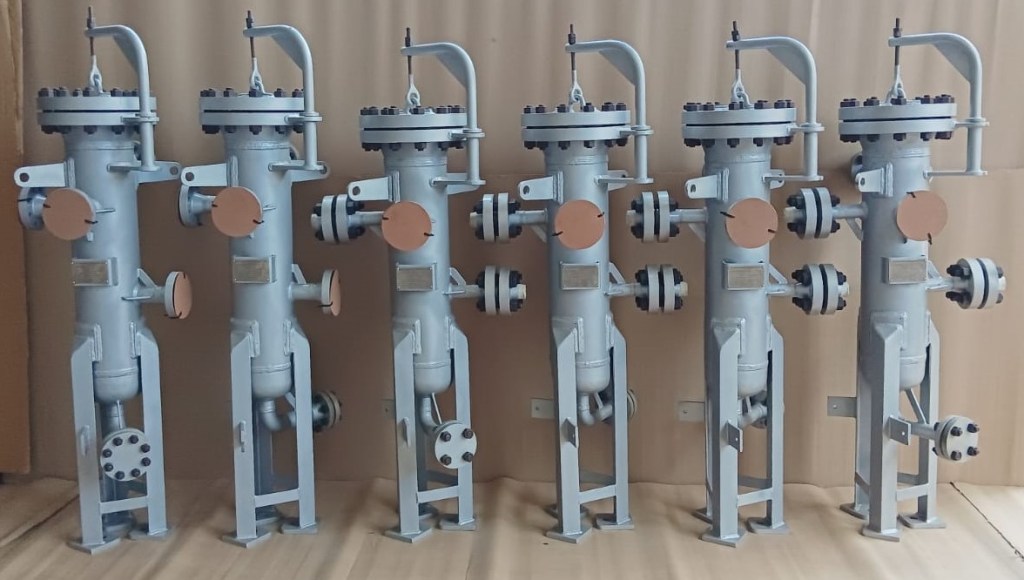
4. T Strainers: Custom-Fit for Tight Spaces
T strainers are often custom-fabricated to meet specific dimensional requirements, especially in industries like oil and gas or chemical processing. They are similar in function to basket strainers but feature a “T” configuration that fits neatly into horizontal piping systems.
T strainers offer high-capacity filtration and are typically used when space constraints or unique flow conditions require a tailor-made solution.
5. Duplex Strainers: Nonstop Filtration for Critical Systems
Need continuous operation without shutdowns? Duplex strainers provide a dual-chamber setup that allows one side to be cleaned while the other remains in service. This is critical in industries where flow interruption is not an option, like power plants, fire protection systems, or high-stakes manufacturing lines.
These strainers are often equipped with a diverting valve for seamless switching, making them the top choice when reliability and uptime are non-negotiable.
How to Choose the Right Strainer for Your Operation
Choosing the right strainer isn’t just about flow rate or pipe size. Here are a few key considerations:
- Media type: Is it water, gas, oil, or something corrosive?
- Debris load: Are you filtering out fine particles or heavy solids?
- System pressure and temperature: Can the strainer withstand your process conditions?
- Maintenance access: How often do you want to clean or replace elements?
Working with experienced strainer manufacturers in the USA, like SG Industrie,s means you get not just off-the-shelf products, but solutions engineered to meet your specific operational needs.
Final Thoughts
From Y strainers that handle high-pressure systems to basket strainers that offer large dirt-holding capacity, each strainer serves a unique role in industrial flow systems. And with options like temporary and duplex strainers, you can optimize both performance and uptime.
At SG Industries, we’re not just here to supply—we’re here to solve. Our team is always ready to help you select, customize, and implement the right filtration equipment for your application.
Have questions or need a quote? Let’s talk. Because clean flow means fewer problems—and that’s what we’re here for.
Frequently Asked Questions
A basket strainer is ideal for high-flow systems and is easier to clean, while a Y strainer is more compact and suitable for systems with higher pressure or where space is limited.
Temporary strainers are best used during system startup or commissioning to catch debris like rust or construction residue. Once the system is clean, they are usually replaced with permanent strainers.
Duplex strainers allow for continuous operation since one chamber can be cleaned while the other remains active, making them perfect for critical systems where shutdowns are not an option.
Recent Comments